It’s the end of the month.
Operations Lead Taryn has four bank portals open on one monitor, a spreadsheet tracking which payroll files uploaded cleanly on another, and a batch she submitted six hours ago that still has no clear status on her laptop.
Then comes the dreaded ping: a client support request.
“Did Maria in Brazil get paid?”
Taryn wishes she could answer immediately. Instead, she forwards the message to Eddie on her team. To investigate, he needs to open another portal, find the transaction, download a report, and match payment reference numbers against the payroll register.
Just another cross-border payroll run across fragmented systems.
Taryn’s problem isn’t that her team cannot send payroll. It’s that the team cannot immediately see whether payroll is complete for every employee.
That gap is more than an operational convenience for employers and the payroll providers, EORs, and workforce platforms supporting them. It means more manual investigation, slower client support, harder reconciliation, and less control over the moment that matters most: payday.
In payroll, 99% is not good enough
A payroll run in which 99% of payments arrive on time is not a success for the remaining 1% of employees. Someone is still waiting for wages they expected to receive on payday — and they expect their employer, EOR, payroll provider, or workforce platform to put it right.
A missed or delayed payment can have many downstream effects:
- An employee unable to access money they were counting on.
- A client escalating an urgent support request.
- Operations teams spending hours tracing payments across systems.
- Finance teams needing to investigate funding, FX, payment status, or returns.
- Support teams having to explain a delay before they understand its cause.
- Trust in the payroll provider or platform beginning to erode.
Payroll providers cannot control every bank, clearing system, or payment rail involved in moving funds to workers. But they can give their clients and operations teams clearer visibility from payment submission through settlement — and the ability to resolve issues faster when something goes wrong.
Hitting “send” does not mean payroll is complete
Payroll technology has improved how teams prepare payroll. It has not always improved what happens after a payroll file is approved and released for payment.
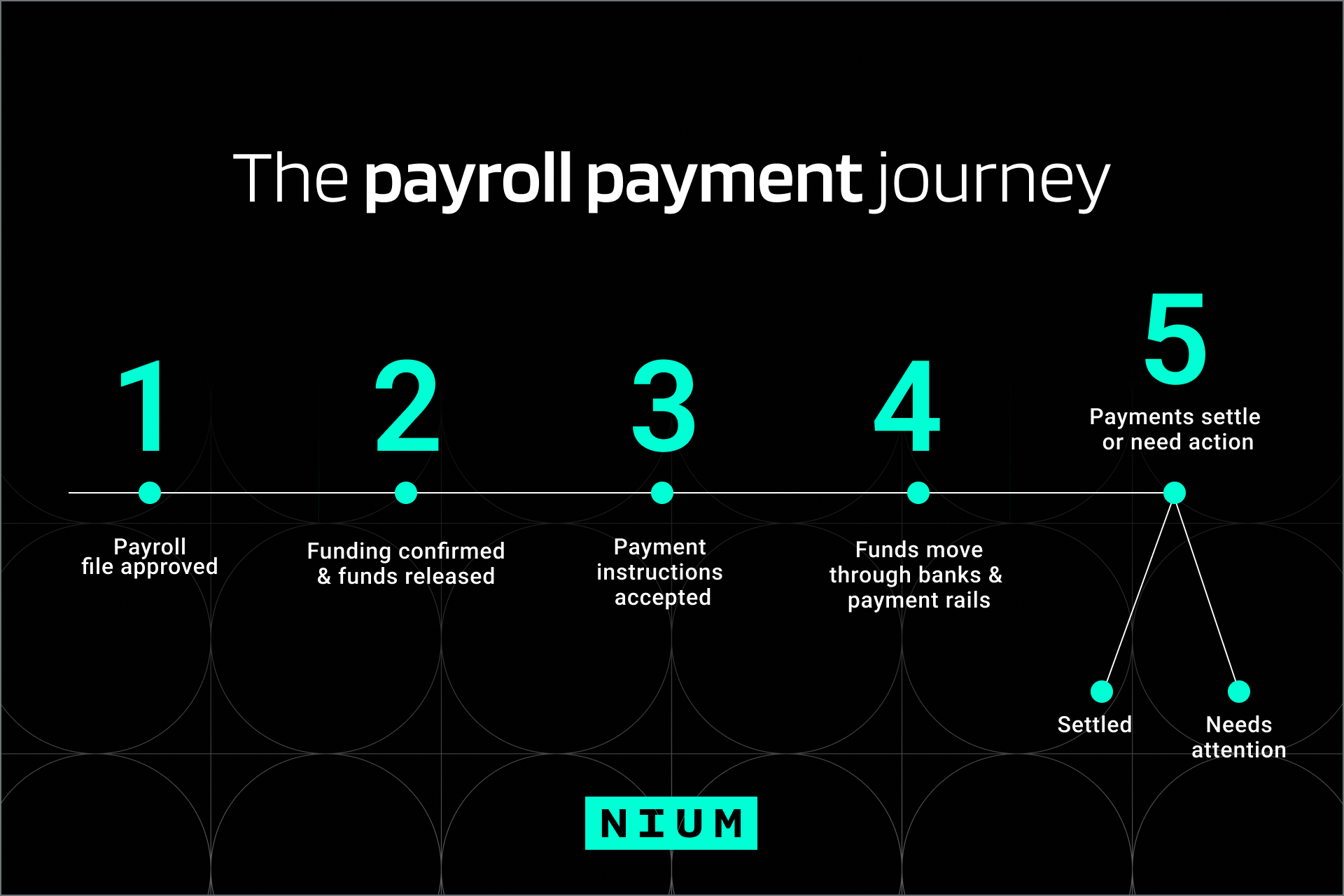
Once a payroll file is approved, payment instructions and funds still must move through banks and payment rails before workers can access their pay.
A payroll batch can show as processed while individual payments are still pending. Funds can leave the originating account before reaching the beneficiary bank. Or that beneficiary-data issues may not surface until a payment is rejected or returned.
For payroll providers, EORs, and workforce platforms, the challenge is not simply initiating payments. It is understanding the latest confirmed status of each payment — and acting early enough to prevent an exception from becoming a client escalation or a delayed payday.
Smooth payroll is transparent, timely, and verifiable
A smooth payroll run gives payroll teams confidence throughout the payment journey. They can see the latest confirmed status of each payment, identify what needs attention early, and answer whether employees are on track to be paid when promised.
At Nium, we call this certainty in motion: the ability to follow payroll payments as they move, understand what requires action, and maintain confidence through payday.
In practice, a smooth payroll payment experience means:
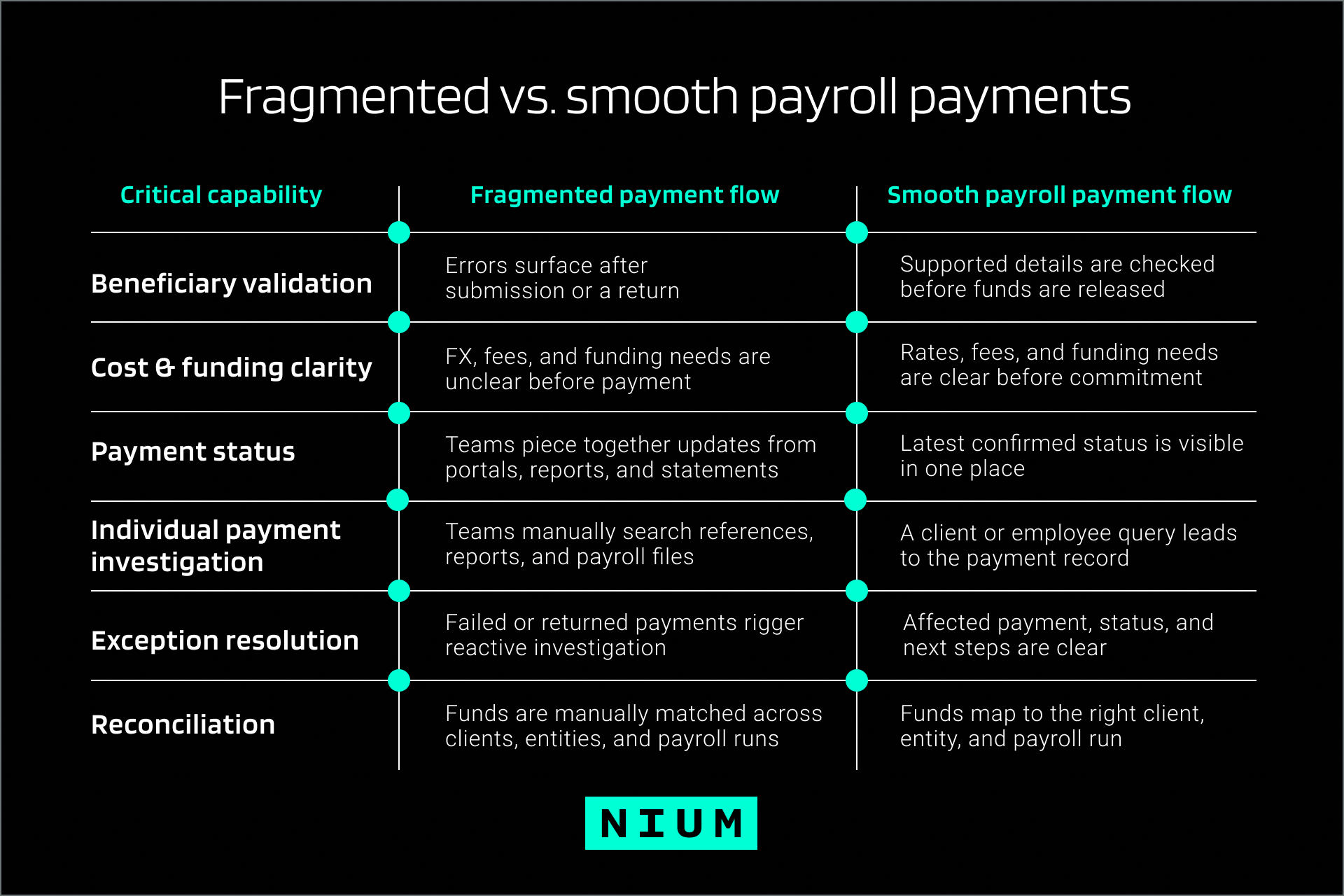
- Payment status is visible. Teams can see the latest confirmed status of funds, including which payments have settled, which are pending, and which require attention.
- Costs are clear before release. FX rates, payment fees, and funding requirements are understood before a payroll run is submitted.
- Beneficiary issues are identified early. Supported account or beneficiary-data issues can be surfaced before payment release, reducing avoidable returns.
- Individual payments are easy to investigate. A client or employee query can be traced to the relevant payment without searching through multiple portals, reports, and payment references.
- Exceptions are actionable and reconcilable. Teams can identify the affected payment, understand its status or return information, take the next operational step, and associate funds with the right client, entity, or payroll run.
How earlier visibility changes the outcome
Consider Maria, an employee in Brazil whose wages didn’t arrive on time.
After investigating, Eddie discovers her bank account details had changed.
In a fragmented process, the payroll file is released before the issue is found. It may only become clear when the payment is rejected or returned. Maria receives her wages late, and her employer wants an explanation.
In a smoother payment flow, Maria’s beneficiary details would have been checked before release, where the payment route supports validation. The invalid details would have been flagged while there was still time to correct them. No support case, reissue or return.
That’s the operational value of earlier visibility.
It doesn’t just make issues easier to investigate. It changes when the team can act — and, in the best cases, prevents a payment problem from becoming an employee problem.
Fragmentation rarely announces itself
Payroll rarely becomes difficult overnight. The pressure tends to build as volumes rise, new markets are added, and teams manage more client entities, payment routes, and exceptions.
The signs are usually operational before they become visible to clients:
- Is reconciliation taking longer than it should?
- Has exception handling become a permanent part of someone’s role?
- Does answering “Did this person get paid?” require logging into another portal or searching through a report?
- Do clients or employees report failed or delayed payments before your team can see an issue internally?
- Is it difficult to understand funding requirements, FX rates, and payment fees before a payroll run is released?
- Do operations teams need to manually match transaction references, bank statements, and payroll registers to understand what happened?
If you answered yes to most of these questions, your payroll payment process may be creating more uncertainty than your clients’ operations teams can afford.
Improving payroll payments does not require replacing everything
Better visibility does not mean changing every bank relationship, payroll provider, or payment process at once.
For payroll providers and workforce platforms with strong engineering teams, building some capabilities internally may be possible. But payment connectivity is only the starting point. A durable payroll payment operation also requires:
- Payment-status models across markets and rails.
- Beneficiary-data requirements and validation logic.
- Return-code handling and exception workflows.
- Funding and treasury processes.
- FX and fee visibility.
- Reconciliation across clients, entities, and payroll runs.
- Operational tools for support, finance, and payroll teams.
- Ongoing updates as bank requirements, payment rails, and local rules change.
The question is not only whether a business can build these capabilities, but whether maintaining them is a long-term strategic priority.
A payments infrastructure partner offers another route without requiring a wholesale replacement of existing relationships.
Providers can start with the market, payment route, or workflow creating the most friction, run a new route alongside the existing process, compare outcomes, and expand gradually.
That makes payroll-payment improvement a phased operational change, rather than a large-scale infrastructure replacement.
At month-end, payroll should feel uneventful
Now imagine Taryn’s payroll run with a smoother payment experience.
She has one view open on her screen. She can see which payments have settled, which are still progressing, and which need attention. She doesn’t have to search through portals, download reports, or match reference numbers before responding to a client.
When the message appears — “Did Maria in Brazil get paid?” — her first reaction isn’t stress.
Taryn checks the payment record, sees the latest confirmed status, and responds with confidence: “Yes, Maria has been paid.”
Deliver more certainty to every payday. Explore Nium for payroll providers.