
Stablecoin cards let businesses spend a stablecoin balance anywhere Visa or Mastercard is accepted, with the issuer converting to fiat at checkout, so the merchant never sees anything different. Five use cases already work today: employee travel, contractor and freelancer payouts, vendor payments, marketplace payouts, and treasury spend-balance management, each solving a specific cost or timing problem in B2B payments.
The quick answer
- A stablecoin card works like any other card at checkout, but instead of funding from a bank account, businesses fund it from a stablecoin balance. The issuer converts to fiat in real time.
- Five proven B2B use cases exist today: employee travel and expense, contractor and freelancer payouts, vendor and supplier payments, marketplace and platform payouts, and treasury spend-balance management.
- Crypto card spending crossed $18 billion in annualized volume in January 2026, driven mostly by stablecoin-funded transactions, precisely because the format asks nothing new of the merchant on the other side.
- Card issuance licensing is set market by market, not globally, so businesses must confirm infrastructure partners already holds the license each market requires before they commit.
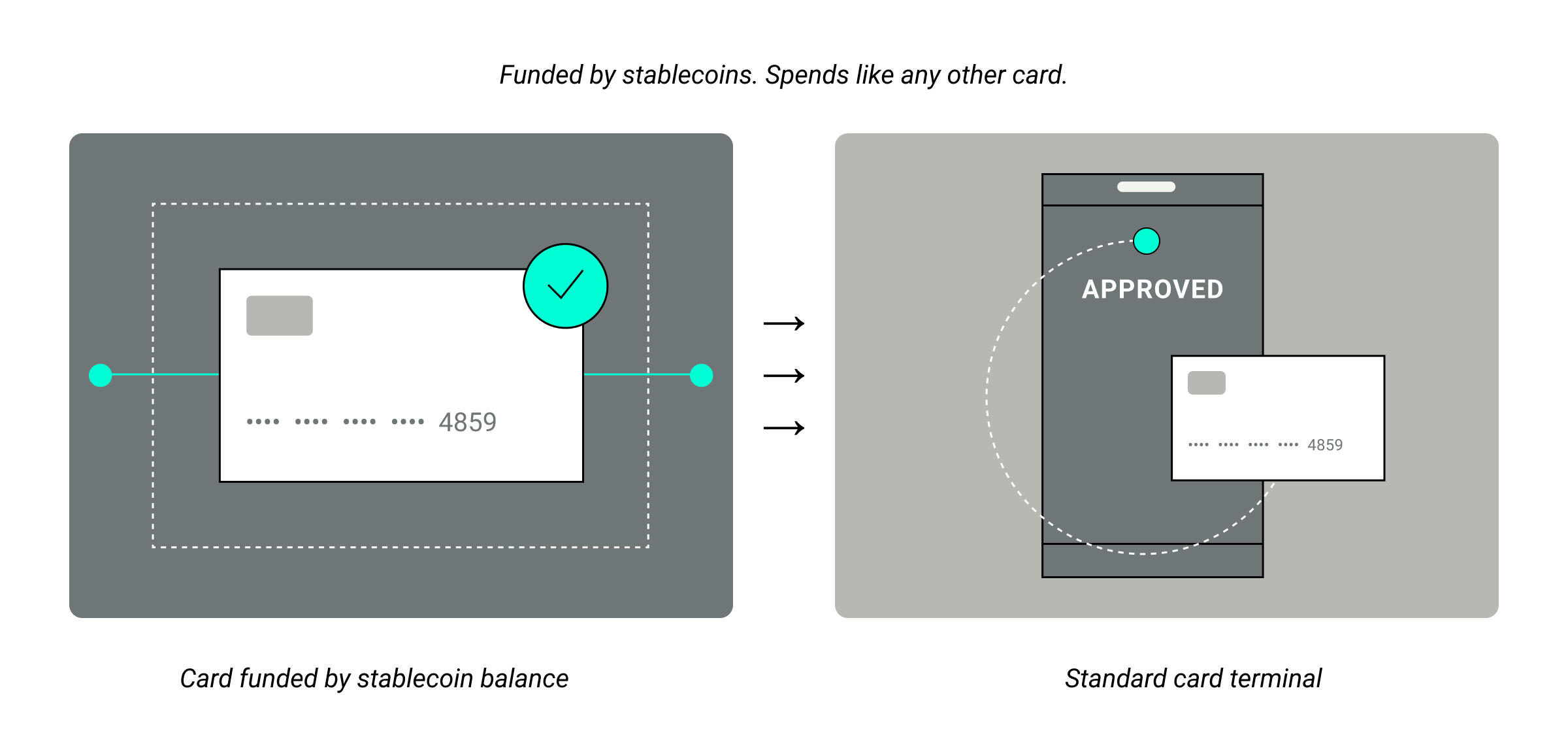
A stablecoin card looks and works like any other Visa or Mastercard card at checkout. What's different is what funds it: instead of drawing from a bank account, the card pulls directly from a stablecoin balance, usually USDC or USDT, and converts it at the point of sale.
That single mechanic opens a set of B2B use cases that have moved well past crypto-native companies experimenting into ordinary finance and operations teams paying real bills.
This piece breaks down five of them: employee travel and expense, contractor and freelancer payouts, vendor and supplier payments, marketplace and platform payouts, and treasury spend-balance management.
Each one is a card-based expression of the same shift covered in our guide to stablecoins in B2B payments: getting money to move without the delay and cost of a correspondent-banking chain, just applied at the point a business or recipient needs to spend it rather than settle it.
How stablecoin cards work
A stablecoin card sits on top of a stablecoin balance the same way a debit card sits on top of a bank balance.
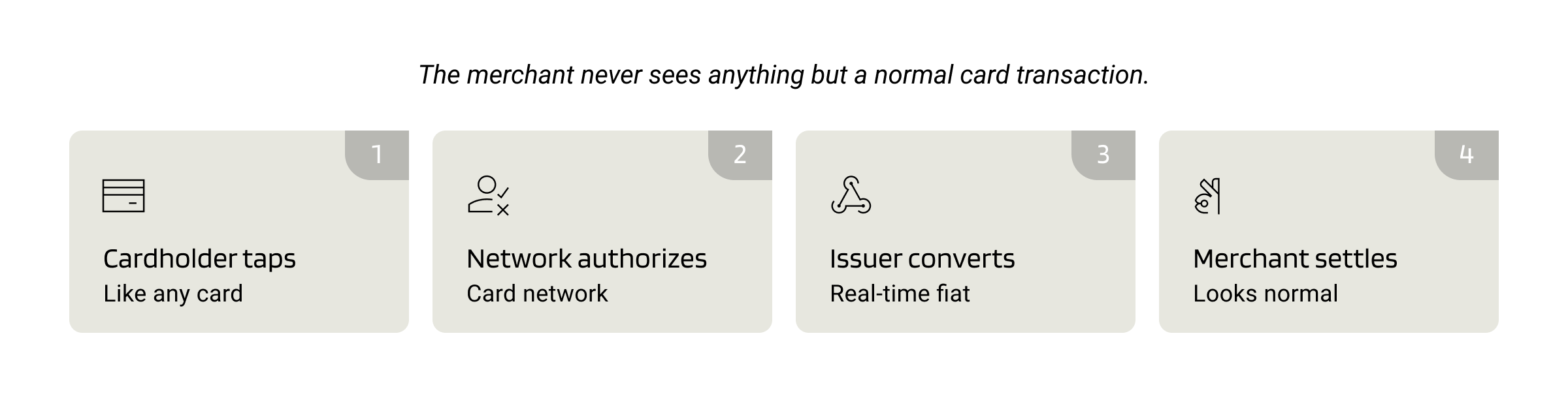
When a cardholder taps or swipes, the card network authorizes the transaction, and behind the scenes the issuer converts the necessary amount from the stablecoin balance into fiat currency in real time.
The merchant never sees anything other than a standard Visa or Mastercard transaction settle. They don’t need to accept crypto, hold a wallet, or change anything about how it processes payments.
That invisibility is the point.
Crypto card spending crossed $18 billion in annualized volume in January 2026, with stablecoin-funded transactions driving most of the growth, precisely because the format asks nothing new of the person on the other side of the transaction.
Some programs add spend controls on top of that: limits tied to specific merchant categories, date ranges, or single transactions, giving businesses the same granular control over a stablecoin-funded card that they already expect from a traditional corporate card program.
1. Employee travel and expenses
Employee travel is where the foreign transaction fee shows up most visibly for businesses. Traditional bank and card issuers charge roughly 2.9% to 3% on every foreign-currency purchase, on top of ATM fees that can run $3 to $5 per withdrawal.
For companiesspending $50,000 a year on international travel, even a 2% markup adds $1,000 in costs that never shows up as a line item anyone questions.
Stablecoin cards remove that variable because the underlying balance is already dollar-pegged. There’s simply no foreign-currency conversion step for the bank to charge.
It's the same mechanic behind Nium's own stablecoin-backed card platform, which gives our customers a dollar-pegged balance for employee spend without having to build a travel-card product of their own.
Some programs layer travel-specific controls on top: a card that only activates for a set trip's date range, or restricts spending to travel-related merchant categories, giving finance teams visibility into exactly what a trip cost without waiting for an expense report.
2. Contractor and freelancer payouts
A stablecoin transfer solves the speed and cost problem of paying a contractor across a border, but it leaves the contractor holding a wallet balance they still need to convert into something spendable, usually through a local exchange or a peer-to-peer off-ramp.
A stablecoin-funded card skips that step: businesses fund the card from their stablecoin balance, and contractors can spend directly anywhere Visa or Mastercard is accepted, without opening a crypto exchange account or managing a wallet.
That matters most for contractors in markets where local banking infrastructure is thin, or where opening a bank account as a foreign contractor is its own bureaucratic project.
Deel already processes stablecoin payouts for more than 10,000 contractors across 100 countries, totaling over $250 million paid out, and pairs the payout with a card so contractors can spend the balance directly rather than converting it manually first.
It's the same workflow you can build on top of Nium's stablecoin card issuance platform if you run a payroll or contractor-management platform, without having to run the card program yourself.
The compliance work doesn't disappear here, it just moves earlier into the process.
Worker classification, tax reporting, and AML and KYC checks still apply to a card-funded payout the same way they apply to any other cross-border disbursement. A card changes what happens after the money clears, not what’s needed to verify beforehand.
3. Vendor and supplier payments
A stablecoin-funded virtual card gives a procurement or accounts payable team a version of the invoice-matched control that's hard to get from a wire or an ACH transfer.
A card issued against a specific vendor can be locked to that merchant, capped at the exact invoice amount, and set to expire in a fixed window, so suppliers can only charge what was approved and nothing more.
That level of control has a measurable fraud benefit.
Businesses using virtual cards reported fraud on roughly 5% of programs in 2024, well below the rates seen on checks and ACH payments, largely because a single-use or vendor-locked card simply can't be charged outside its preset rules.
Funding those cards from a stablecoin balance instead of a bank account adds a second benefit if suppliers are cross-border: the issuer settles against the underlying stablecoin rail, rather than routing every vendor payment through a separate wire.
4. Marketplace and platform payouts
The card use case scales differently for platforms than it does for a single company paying contractors, since marketplaces might be settling thousands of seller or creator payouts a day rather than a handful.
Two of the largest content platforms already moved on this: YouTube began letting US creators receive ad revenue in PYUSD, PayPal's dollar-pegged stablecoin, in December 2025, and Meta started paying creators in USDC through April 2026, launching in Colombia and the Philippines with plans to expand to more than 160 countries.
Pairing that payout with a card, rather than leaving screator or sellers holding a wallet balance, is what turns a stablecoin payout into something they can spend without a separate off-ramp step, the same gap a card closes for a contractor payout.
For platforms, this usually isn't something built in-house. It's added through an embedded finance provider's API, the same shift covered in our piece on the rise of embedded finance, where card issuing and payouts become a feature to turn on, rather than a bank charter applied for.
5. Treasury and spend-balance management
Two funding models exist for stablecoin card programs, and they matter for how treasury manages risk.
A prefunded model, the more common one, has businesses depositing stablecoins into a balance the card draws down as employees or contractors spend, working the same way a prepaid card program does today, just funded in USDC or USDT instead of dollars.
The less common alternative works through collateral rather than a prepaid balance. Businesses deposit stablecoins into a smart contract, and a line of credit gets extended against that collateral, fronting the fiat to merchants and settling from the collateral afterward instead of drawing from a prefunded pool.
Either model solves a problem traditional card programs have struggled with: funding on a schedule that doesn't match when money is needed.
With stablecoin-backed cards, a card program's US account can get funded in stablecoins and converted to dollars in real time, including nights, weekends, and holidays, instead of waiting on the banking-hours cutoffs that govern a traditional ACH or wire funding cycle.
For treasury teams running card programs across several markets, this removes the specific friction of timing a transfer around a bank's operating calendar just to keep a program funded.
Who's building stablecoin card programs
No single company owns this category yet, and the players split cleanly by role: card issuers who build and run their own programs, and the networks and infrastructure providers that other issuers plug into.
The practical difference for businesses evaluating this space: Reap and Rain are dedicated stablecoin-first issuers built for companies that already hold stablecoins and want to spend them. Ramp and Brex are traditional corporate card platforms that added stablecoin funding as one option among several.
Nium sits in the infrastructure layer, having launched a stablecoin card issuance platform in 2026, issuing the cards directly rather than running a single branded program.
That matters most for businesses wanting a stablecoin card option alongside cards funded the traditional way, rather than a separate, parallel program.
What to watch: compliance for cross-border and payroll use
Card issuance licensing is set market by market, not globally, which is easy to miss when a provider's marketing talks about "global" reach.
For example, launching a euro-denominated card program in the EU requires an infrastructure partner that either holds an Electronic Money Institution license directly or maintains a primary relationship with one.
The same pattern repeats with local variations elsewhere: the UK runs its own FCA and Bank of England e-money rules, Singapore requires a MAS license, and Japan restricts stablecoin issuance to banks and trust companies.
For programs covering contractor or marketplace payouts specifically, worker classification and AML and KYC checks still apply per market, the same way they would for any cross-border disbursement, card-funded or not.
The practical question worth asking potential infrastructure partners isn't whether they support a given country. It's whether they already hold the license that market requires or would need to add it after you're already committed.
A provider with existing licenses across dozens of markets, Nium included, is generally further along on this than one built for a single market first.
Frequently asked questions
- What is a stablecoin card? A card that works like any other Visa or Mastercard at checkout, but draws from a stablecoin balance instead of a bank account, with the issuer converting to fiat in real time so the merchant sees a standard transaction.
- What are the main B2B use cases for stablecoin cards? Five proven ones: employee travel and expense, contractor and freelancer payouts, vendor and supplier payments, marketplace and platform payouts, and treasury spend-balance management.
- How do stablecoin cards save money on employee travel? They remove the foreign transaction fee entirely, since the underlying balance is already dollar-pegged and needs no currency conversion, versus the roughly 2.9% to 3% traditional issuers charge.
- Do contractors need a crypto wallet to get paid with a stablecoin card? No. The card lets them spend directly from the funded balance anywhere cards are accepted, without opening a crypto exchange account or managing a wallet themselves.
- Are stablecoin-funded virtual cards more secure for vendor payments? Yes, when locked to a specific merchant and invoice amount: businesses using virtual cards reported fraud on roughly 5% of programs in 2024, well below check and ACH fraud rates.
- Which companies are paying creators or sellers in stablecoins today? YouTube began PYUSD payouts to US creators in December 2025, and Meta started paying creators in USDC through Stripe in April 2026, expanding to more than 160 countries.
- Is stablecoin card issuance licensing global or market-by-market? Market by market. Confirm your infrastructure partner holds the specific license each market requires, an EMI license in the EU or a MAS license in Singapore, for example, rather than assuming broad "global" coverage.
- What's the difference between a prefunded and a collateralized stablecoin card model? A prefunded model draws down a stablecoin balance you deposit in advance, like a prepaid card; a collateralized model extends credit against stablecoins you post as collateral, settling from that collateral afterward.
The bottom line
Five use cases, one underlying mechanic for businesses: a stablecoin balance that anyone can spend without a separate conversion step first.
Employee travel and expense removes foreign transaction fees. Contractor and freelancer payouts remove the need for recipients to hold a wallet. Vendor and supplier payments add invoice-level spend control. Marketplace and platform payouts scale the same idea to thousands of recipients at once. Treasury and spend-balance management is what keeps all four funded, without the timing constraints of a traditional banking calendar.
None of these use cases require businesses to become a crypto company first. The mechanic sits underneath a card that works exactly like any other, which is why adoption has moved past pilot programs and into ordinary finance and operations work.
How Nium can help
Nium's stablecoin card issuance platform lets you issue Visa- and Mastercard-branded cards funded directly from stablecoin balances, through the same API and licensing infrastructure that already powers Nium's payouts and card programs across 190+ countries. That means you can build a stablecoin card program for any of the five use cases above, travel, contractor payouts, vendor spend, marketplace payouts, or treasury management, without also becoming a crypto company first, or stitching together a separate provider per market.
Explore Nium's stablecoin-linked cards to see what a program could look like for your business.