

Earlier this year, Nium surpassed $200 million in annual recurring revenue (ARR). We’ve doubled revenue in three years, and we’re focused on making our next stage of growth profitable.
That puts us among a select group of private fintech companies focused on serving businesses in cross-border payments. It’s a big deal, and we should enjoy it, it's fun to see hard work pay off.
But as CFO, what makes me proud isn’t the milestone, it’s the things we’ve learned on the journey.
The second $100M is different.
Before joining Nium, I was a technology investment banker for 15+ years. I've watched dozens of companies reach major revenue milestones, pop the champagne, and believe they’d arrived at the promised land.
Often, that was when things got really hard and cracks in the foundation start to show.
I used to draw this simple chart for CEOs: the rapid climb of a technology company alongside the slower, incremental growth of an offline business.
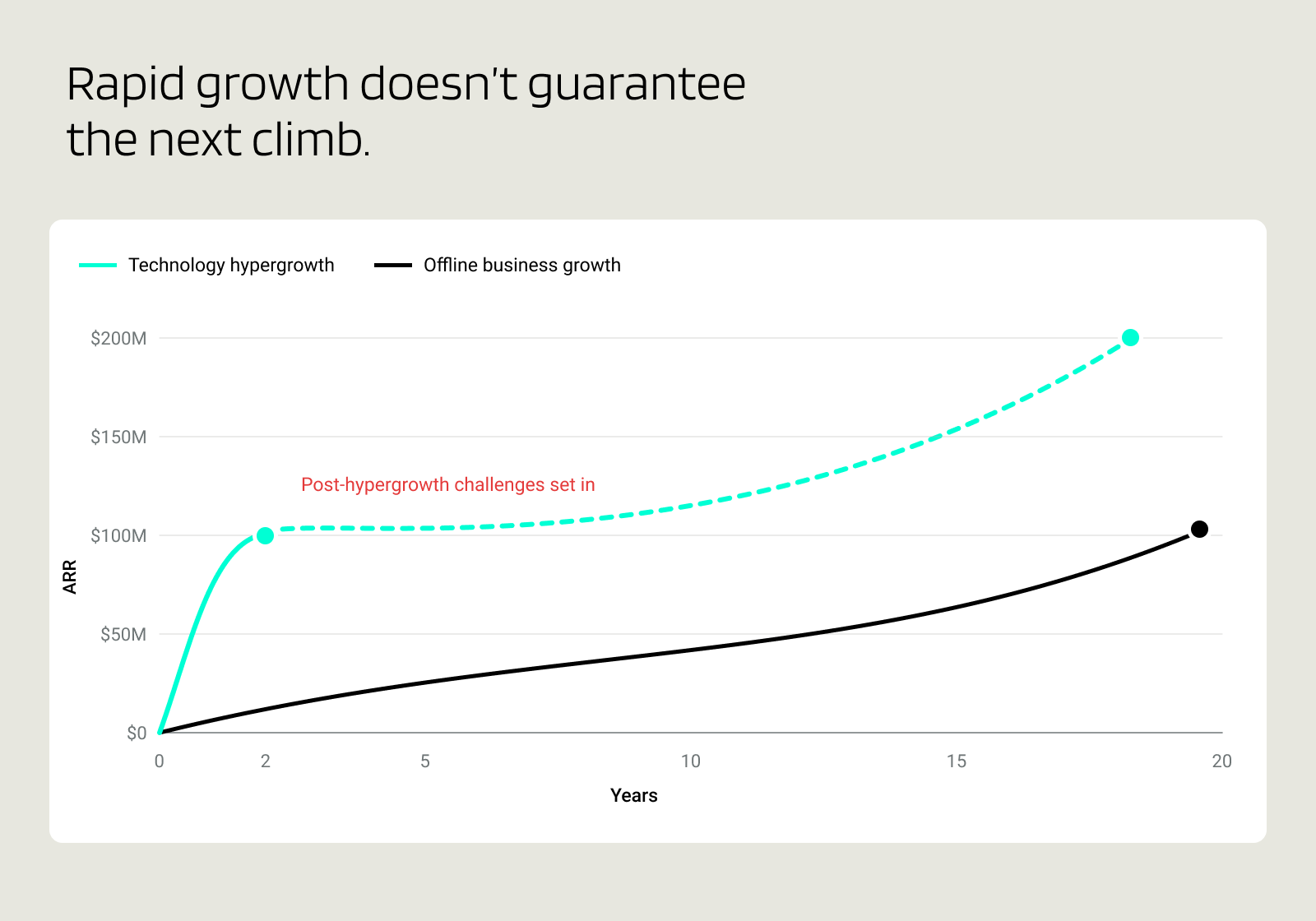
The first climb can be extraordinary in any new sector. But hypergrowth can also hide things: overspending, manual processes, lack of controls, ‘tech debt’, weak unit economics. As reality sets in, those things become harder to ignore.
At $100 million, another 50% of growth means finding $50 million in revenue; this is no easy feat for any company. You’re managing a larger business, there are competing priorities, competitors start to notice you, and customers expect more.
Getting to $200 million isn’t simply repeating what got you to $100 million. It's building systems and infrastructure for the next wave of growth
$200M takes a lot of things done right.
Getting to this point wasn’t one grand breakthrough. It was a series of hundreds of decisions and thousands of hours of focus that made Nium stronger in three ways.
First, we sharpened our customer focus. We got more disciplined about which customers we serve and how we prioritize onboarding. Our founder and CEO, Prajit, regularly asks customers directly what we could do better. We often incorporate that feedback into our roadmap, assign resources, and act. The goal is straightforward: get customers to value faster.
Second, we began simplifying the business. Acquisitions and years of platform additions have created technical complexity. Merging companies is one thing; merging technology is another. We’re streamlining that infrastructure and replacing more manual work with automation, AI, or both.
Third, we strengthened how we execute. We put experienced leaders in pivotal roles and introduced company-wide objectives and key results (OKRs), so everyone understands how their individual work contributes to the business — and how success is measured.
The common thread has been financial discipline: delivering value sooner, building lasting customer relationships, and becoming more efficient as we scale. Growth alone isn’t enough. The economics have to work, too.
Bigger ambitions. A higher bar.
Being more deliberate about how we operate also helps us choose where to invest next.
We’re investing in what we do well — cross-border payouts — while putting appropriate resources behind opportunities such as stablecoins and stablecoin card issuing. We can strengthen today’s business and build for tomorrow without treating every new idea as a reason to spend.
We’re also clear-eyed about what comes next. Competition will get tougher. Expectations from customers, employees, and stakeholders will rise. We still have things to fix.
Crossing $200 million doesn’t give us permission to relax, it raises the bar.
But today, we should recognize the people who fought hard to hit this milestone and the customers who helped us earn it. We took our lumps. We learned. We made changes. We kept growing.
Here’s to the next climb. We’re ready to take it on.