
Stablecoins now handle three real B2B jobs for businesses: paying cross-border suppliers, settling money between subsidiaries, and paying contractors, replacing slow, expensive correspondent-banking transfers with settlement in seconds. The GENIUS Act and MiCA gave this legal footing in 2025 and 2026, but the two frameworks still don't fully agree, so businesses should always check which one their issuer satisfies.
The quick answer
- Stablecoins now handle three proven B2B jobs for businesses moving money: cross-border supplier payments, intercompany treasury settlement, and contractor payroll, each solving a specific correspondent-banking pain point rather than replacing existing rails.
- The GENIUS Act (US, July 2025) and MiCA (EU, fully enforced 2026) gave stablecoins enough regulatory footing to move from pilot to default, but the two frameworks disagree on reserve composition, so businesses should confirm which one their issuer satisfies if they run both US and EU corridors.
- Stablecoin settlement isn't a Swift or real-time-rail replacement. It's a fourth option to route specific cross-border flows through when correspondent banking is the bottleneck.
- The next frontier is spending, not just moving money: stablecoin-backed cards let businesses or contractors spend a stablecoin balance anywhere Visa or Mastercard is accepted, without a crypto-native workflow.
"Stablecoin" used to signal a crypto-native curiosity: a hedge against volatility, mostly circulating between exchanges and wallets. That's no longer an accurate description of how the term shows up inside payments and treasury operations.
In 2026, stablecoin settlement has moved from pilot programs to a working part B2B payment operations for a specific, narrow set of flows: cross-border supplier payments, intercompany treasury settlement, and contractor payroll disbursements.
Regulatory clarity, including the US GENIUS Act, signed into law in July 2025, and MiCA's full enforcement across the EU, removed the biggest reason finance teams held back. That clarity is why 2026 is the first year stablecoin settlement functions as a practical default for some B2B flows, rather than an experiment layered on top of them.
This guide covers what stablecoins for B2B payments are, which use cases have moved past the pilot stage, how they compare to the payment rails B2B paymentsalready run on, and where the US and EU regulatory frameworks still conflict.
TL;DR: Stablecoins aren't replacing real-time payments or Swift. They're simply becoming one more rail that runs alongside both.
What stablecoins are and why 2026 is the year they stopped being experimental
A stablecoin is a digital token designed to hold a fixed value, usually pegged one-to-one to the US dollar and backed by reserves of cash and short-term government debt.
That reserve backing is the entire point. Unlike Bitcoin or Ether, a stablecoin isn't supposed to move in price, which is what makes it usable for something as unglamorous as paying supplier invoices rather than speculating on price swings.
Two tokens dominate the category
Tether's USDT holds roughly 59% of total stablecoin supply, while Circle's USDC leads on a different measure: annual transaction volume, where it processed $18.3 trillion in 2025 against USDT's $13.3 trillion despite the smaller supply share.
That gap signals USDC sees heavier use in payments specifically, rather than exchange trading; a distinction that matters for B2B buyers, since supply share reflects which token is larger, while transaction volume indicates which token is moving money.
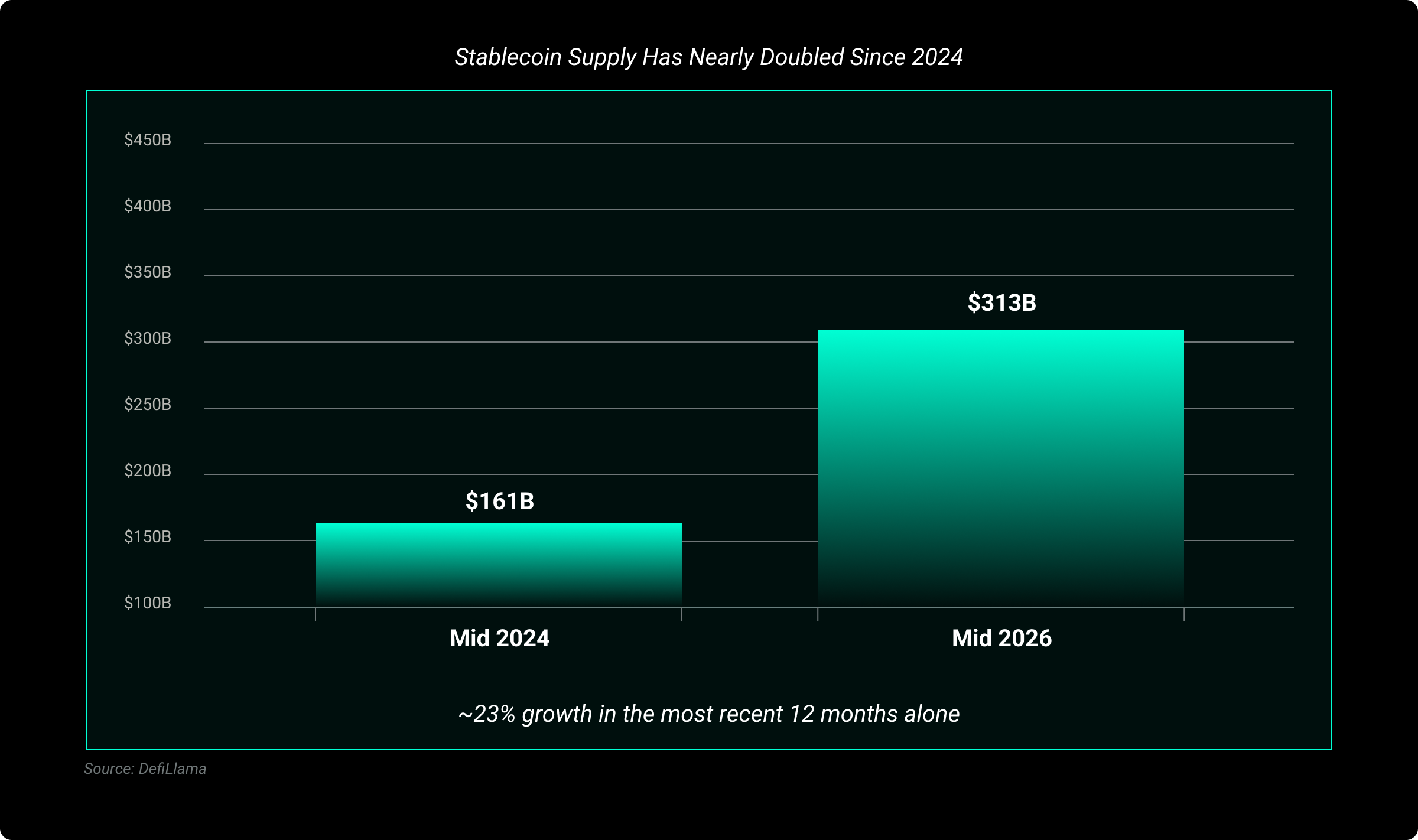
The growth number worth anchoring on is supply, not price, since stablecoins are designed not to move. Total stablecoin supply grew from roughly $161 billion in mid-2024 to roughly $313 billion by mid-2026, a near-doubling in two years, with growth of about 23% in the most recent 12 months alone.
Regulations are maturing
What changed in 2026 wasn't the technology, since settlement finality on these networks has worked for years. It was regulatory permission.
The GENIUS Act, signed into US law in July 2025, formalizes a category called Permitted Payment Stablecoin Issuers (PPSI): entities allowed to issue dollar-backed stablecoins under federal oversight, subject to monthly reserve audits and a 1:1 backing requirement.
That's a lower bar than a full banking charter, but a meaningfully higher one than issuing a token with no oversight at all. That distinction is what convinced risk-averse treasury professionals to stop treating stablecoins as a compliance liability by default.
The EU's MiCA rules moved from partial to full enforcement around the same period, closing the same gap for European finance teams.
Together, those two regulatory shifts are why finance teams that spent 2021 through 2024 treating stablecoins as a crypto-desk experiment spent 2026 running them through treasury and payments operations instead.
The core B2B use cases
Three use cases account for most of the B2B activity happening today, as distinct from the activity vendors project. Each one solves a specific problem with the correspondent-banking system , rather than trying to replace it wholesale.
Cross-border supplier payments
Paying suppliers across borders is the single most-cited stablecoin use case among corporates, named by 77% of respondents in EY-Parthenon's June 2025 survey of 350 corporate and financial-institution executives as the use case they find most compelling.
The appeal is straightforward. A traditional cross-border wire routes through a chain of correspondent banks, each one adding a day and a fee, while a stablecoin transfer settles directly between two parties on a shared ledger.
Finality is measured in seconds rather than days: roughly 400 milliseconds on Solana, about 15 seconds on Ethereum, and two to three seconds on TRON, depending on the network you use.
The corridors where this shows up most are the ones traditional banking serves least: Latin America, Southeast Asia, and parts of Africa, where supplier's domestic bank might not have a direct correspondent relationship with certain banks at all, forcing the payment through two or three intermediary hops instead of one.
That speed difference compounds into real cost savings on volume. 41% of companies already using stablecoins for cross-border payments report savings of at least 10%.
Intercompany treasury settlement
The second use case moves in the opposite direction of a customer-facing payment: cash moving between a company’s subsidiaries rather than to an outside party.
If your treasury team is consolidating balances from a regional entity into a central account, or funding a subsidiary ahead of a payroll run, you face the same correspondent-banking delay internally as you do externally. Take, for example, a regional subsidiary needing to fund a local payroll run on Friday, but your central treasury only initiating the transfer on Wednesday because that's what a multi-day wire requires.
A same-day stablecoin settlement collapses that planning buffer, meaningfully reducing the idle cash the business must keep parked in each market to cover timing risk.
The barrier here isn't the technology so much as integration: 70% of surveyed non-users say they'd adopt faster if stablecoin settlement connected directly to their existing ERP and treasury platforms, rather than requiring a separate workflow.
Contractor and payroll disbursements
The third use case is paying people directly, e.g. contractors and gig workers in markets where a traditional wire is disproportionately expensive relative to the payment size.
A $3,000 cross-border wire to a contractor typically costs $25 to $80 once sender fees, correspondent deductions, and FX spread are counted, and takes one to three business days to land.
The same payment in a stablecoin settles in under a minute for a few cents to a couple of dollars in network fees, a meaningful difference when the recipient is a freelancer in a market where local banking infrastructure is thin.
For companies running payroll across a dozen countries, that difference adds up fast: a handful of dollars in fees replaces what would otherwise be a four-figure sum in wire costs across a single pay cycle, without asking recipients to open a new bank account first.
How stablecoins compare to other B2B payment rails
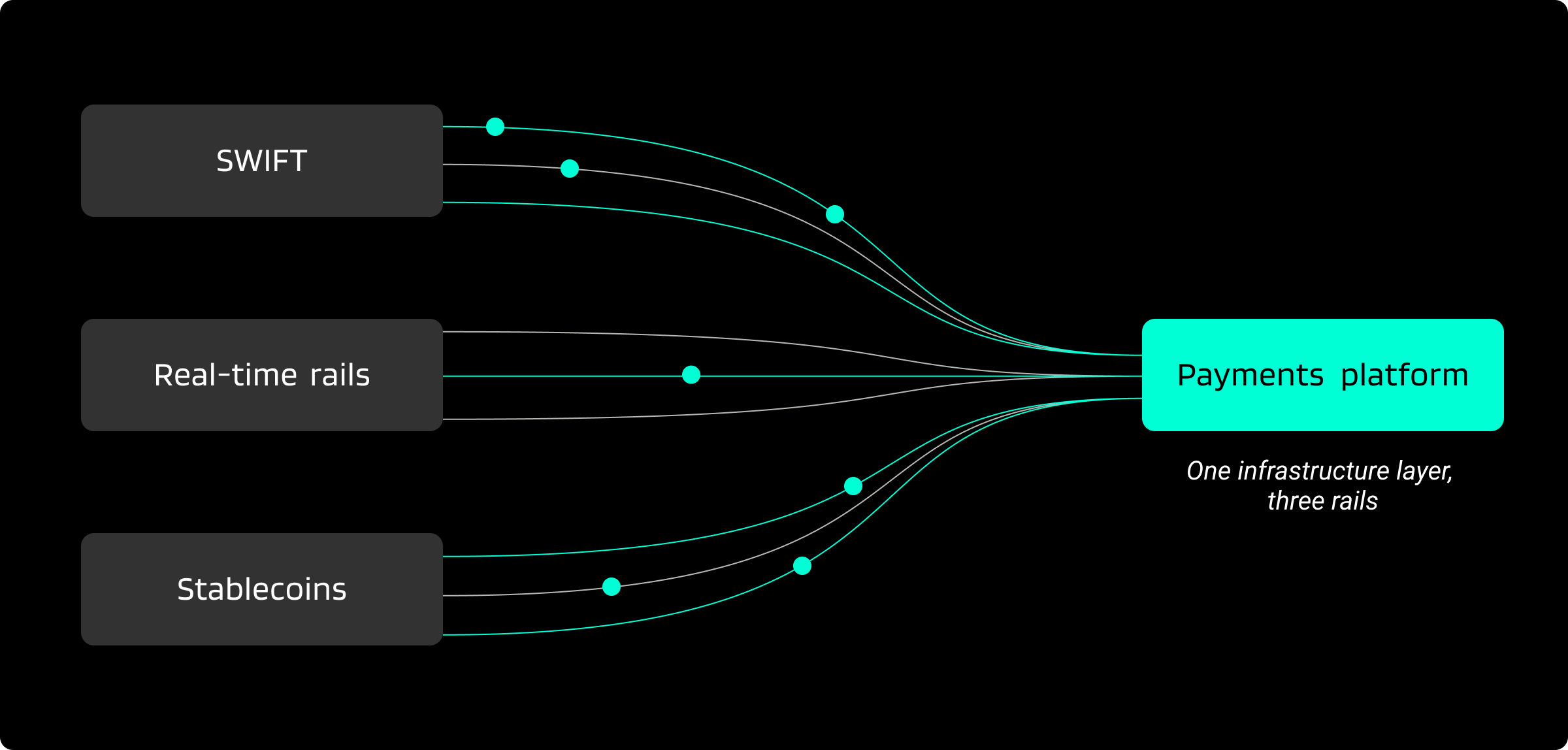
None of this makes stablecoins a replacement for the rails business payments already run on. It's more accurate to treat them as a fourth option alongside three that already exist: Swift and correspondent banking, domestic real-time rails like RTP and FedNow in the US, and now stablecoin settlement, each suited to different kinds of transfers made.
The domestic real-time rails are the fastest-growing part of that comparison.
RTP now reaches 72% of demand deposit accounts in the US through more than 1,200 participating banks, while FedNow covers over 50% of checking and savings accounts through roughly 1,800 institutions.
Both settle in seconds, both run on regulated bank infrastructure with no currency conversion step, and neither charges anything close to a correspondent-banking fee. (For a full breakdown of how RTP and FedNow reach compares across the US market, see our guide to real-time B2B cross-border payment rails.)
Where domestic real-time rails run out of road is the border itself. RTP and FedNow move dollars between US bank accounts; neither touches a payment that needs to land in euros in Frankfurt or pesos in Bogota.
That's the gap Swift has historically filled, at a cost of 2% to 4% and two to five business days once every correspondent bank in the chain takes its cut. Stablecoin settlement fills the same cross-border gap at a fraction of the cost and in seconds rather than days, but without the regulatory maturity RTP and FedNow already have domestically.
That comparison also undersells one detail: the fee advantage assumes both the business and the counterparty are already comfortable holding or converting stablecoins.
If the business is still paying a fiat on-ramp or off-ramp fee at either end, it gives some of that savings back, which is why the advantage shows up clearest on corridors where counterparties already operate onchain.
The practical read on using stablecoins for B2B payments
Use domestic real-time rails for same-currency, same-country transfers where available, since nothing beats regulated bank-to-bank settlement for that case. Reach for stablecoin settlement where payments cross a border and correspondent banking is the bottleneck. Keep Swift as the fallback for counterparties that support neither, still a meaningful share of the world's banks in 2026.
A stablecoin transfer also settles with a timestamped, auditable record by default, simplifying reconciliation against invoices, but only if the receiving system is built to ingest that data.
Bottom line: all three rails are here to stay. Handling stablecoins well means treating it as a routing decision rather than a platform choice.
Fig. 2: How the three B2B payment rails compare on cost, speed, and reach.
The regulatory landscape: GENIUS Act, MiCA, and where they conflict
Two regulatory frameworks did more than anything else to move stablecoins from pilot to default in 2026, and they don't agree with each other on several important details. It’s important to understand the differences, especially for businesses moving money between these corridors.
The GENIUS Act (US)
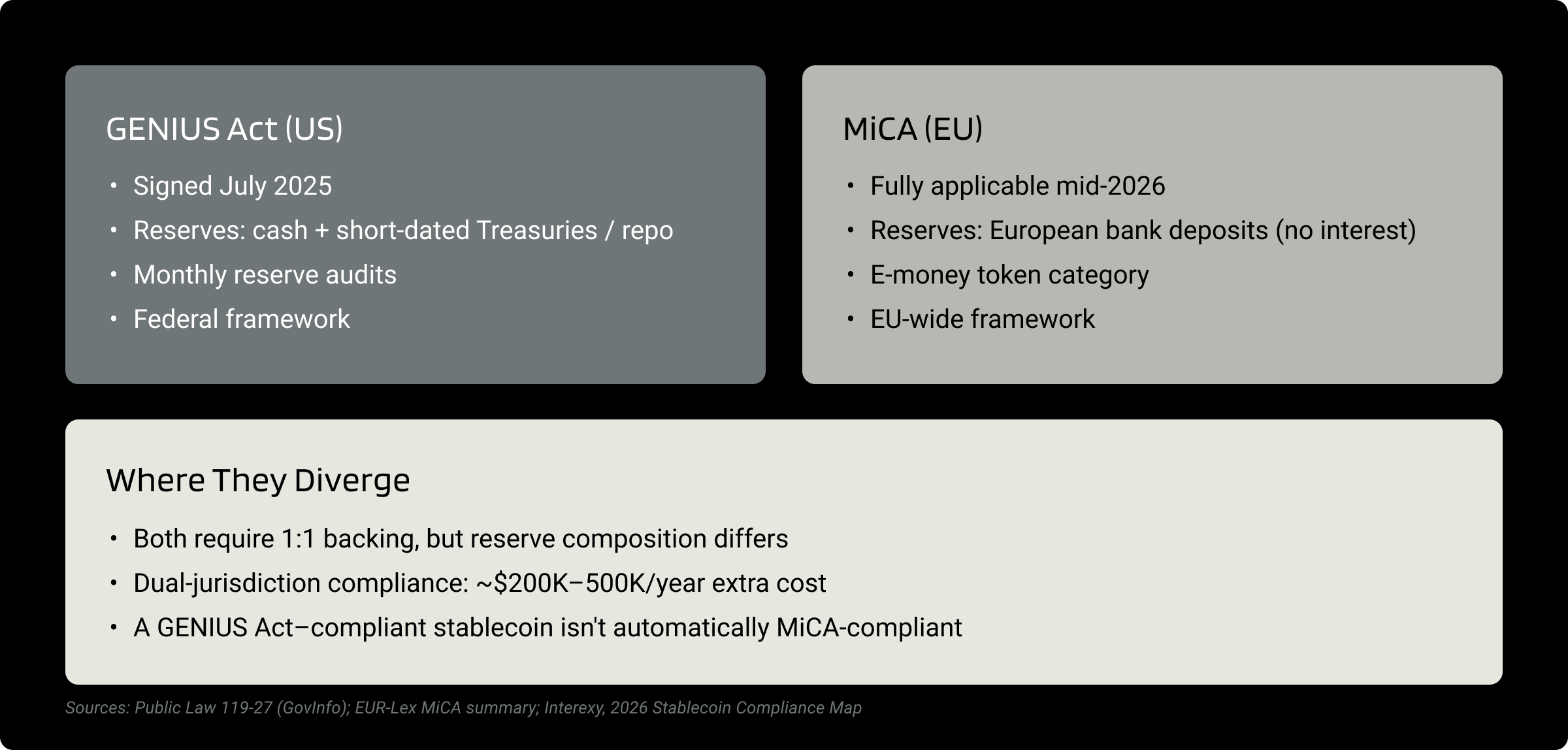
The Guiding and Establishing National Innovation for U.S. Stablecoins Act, Public Law 119-27, signed on July 18, 2025, gave the US its first comprehensive federal framework for payment stablecoins.
It created the Permitted Payment Stablecoin Issuer category referenced earlier: issuers must back tokens 1:1 with cash and short-dated US Treasuries or overnight repo, submit to monthly reserve audits, and hold to strict redemption rules that let a holder convert back to dollars on demand.
The framework covers issuance. It says less about how a stablecoin behaves once it's already moving through a payment stack, which is where compliance questions tend to surface in practice.
Full rulemaking is still catching up to the statute: Treasury is targeting final implementing rules by July 2026, and the OCC's own reporting guidelines, expected around the same time, will determine how granular US disclosure requirements actually become.
MiCA (EU)
The EU's Markets in Crypto-Assets Regulation (MiCA), in force since 2023 and fully applicable across all member states as of mid-2026, regulates stablecoins under a category called e-money tokens.
The redemption and reserve principles look similar on the surface: 1:1 backing, redeemable at par on request, and funds held in low-risk assets. The mechanics differ underneath.
MiCA requires a significant share of an e-money token issuer's reserves to sit in deposits at European credit institutions rather than in short-dated government debt, and it prohibits issuers from paying interest on stablecoins outright, closing off a revenue model that GENIUS Act issuers can still access through Treasury yield.
The compliance runway matters too: the EU set a full-framework transitional deadline of July 1, 2026, meaning firms operating under national exemptions before that date had a hard cutoff to become fully MiCA-compliant or stop operating in the bloc.
Where the two frameworks diverge
The practical friction is reserve composition, not the 1:1 principle both frameworks share. A GENIUS Act issuer optimizes reserves toward short-dated treasuries and repo, which are liquid and currently yield-bearing.
A MiCA-regulated issuer must route a comparable share into European bank deposits instead, a structural difference that compresses margins for any issuer trying to operate compliantly under both regimes at once.
That's expensive in a very literal sense: mid-size operators maintaining separate licenses, compliance teams, and reporting infrastructure across both jurisdictions face roughly $200,000 to $500,000 in additional annual operating cost.
This is the same kind of fragmented, jurisdiction-by-jurisdiction compliance burden covered in our guide to cross-border compliance challenges.
The takeaway for B2B buyers is similar: a stablecoin compliant under GENIUS Act rules doesn't automatically satisfy MiCA's e-money token requirements, so if you're running both US and EU corridors, confirm which framework your issuer actually qualifies under, rather than assuming one covers both.
Whether US disclosure rules end up aligning closely enough with MiCA's transparency mandates to allow real operational overlap is still an open question, worth checking before you assume a single compliance build works on both sides of the Atlantic.
Who's building the rails: issuers, networks, and the infrastructure layer
The stablecoin rail isn't run by any single company. It's built from three distinct layers: the issuers who mint the tokens, the networks that move value between institutions, and the infrastructure providers who plug stablecoin settlement into your existing payment stack.
Knowing which layer a given vendor sits in matters when you're evaluating a partner: an issuer handles the token itself, a network moves value between institutions that already support stablecoins, and an infrastructure provider is the layer that decides whether you have to change how you operate at all.
Circle sits at the issuer layer as the largest regulated player
It moved further into orchestration in April 2026 with CPN Managed Payments, a full-stack platform that lets banks, payment service providers, and fintechs settle cross-border transactions in USDC without holding crypto directly.
Circle handles the minting, burning, and blockchain infrastructure on the backend, while businesses interact entirely in fiat on theirside.
The network already connects to more than 20 blockchains and domestic payment rails, and USDC has facilitated over $70 trillion in cumulative onchain settlement to date, a scale that makes it a credible piece of infrastructure rather than a niche instrument.
Visa operates at the network layer
Its own stablecoin settlement volume shows how fast this shifted: from roughly $4.5 billion annualized in January 2026 to about $7 billion annualized by April, still a small fraction of the $14.2 trillion in total payments Visa processed in 2025.
Nium is one of the participants in Visa's stablecoin settlement pilot, using it to fulfill settlement obligations in USDC across supported blockchains as part of its own multi-rail infrastructure.
Ripple is an example of the settlement layer
Ripple, meanwhile, has built its case on settlement speed for financial institutions specifically, with XRP-based transfers typically finalizing in three to five seconds. That focus has made XRP-based rails a common choice for financial institutions running high-volume remittance corridors and B2B settlement flows, rather than the default for businesses issuing or holding stablecoins directly.
Nium as the infrastructure layer
None of these players replace the infrastructure layer that connects existing payment operations to whichever rail fits a given transfer. Nium's own USDC integration with Coinbase is an example of that connective layer in practice: a payments provider plugging stablecoin settlement into a stack that already runs on cards, real-time rails, and traditional wires, rather than asking businesses to rebuild around crypto rails from scratch.
From payments to cards: where stablecoins are headed next
Everything covered so far treats stablecoins as a way to move money between accounts: paying a supplier, settling between subsidiaries, sending a contractor their invoice total.
There's a second, faster-growing application that starts where those flows end: the moment businesses or recipients need to spend the balance rather than move it.
Stablecoin-backed cards solve that last step.
Instead of converting a stablecoin balance back to fiat through a separate off-ramp before it can be spent, a card ties directly to the balance and converts at the point of sale, so the funds work anywhere Visa or Mastercard is accepted, without either the business or the employee needing a crypto-native workflow.
Visa alone runs more than 130 stablecoin-linked card programs across over 50 countries, a number the company expects to roughly double in 2026.
Nium's own stablecoin card issuance platform, launched this year, lets you issue Visa- and Mastercard-branded cards funded directly by stablecoin balances through a single API integration.
That shift, from settlement to spending, changes who within the business touches stablecoins day to day. Treasury teams managing supplier payments are a different user than an employee booking a flight or a contractor drawing down a payout. Card-based spending is what makes stablecoins usable for that second group without asking them to understand blockchain.
The next piece in this series breaks down exactly which B2B use cases are driving stablecoin card adoption right now, and what to weigh before building a program around one.
Frequently asked questions
- What are stablecoins used for in B2B payments? Three proven flows: paying suppliers across borders, settling money between ubsidiaries, and paying contractors and gig workers, each replacing a slow, expensive correspondent-banking transfer with settlement in seconds.
- Are stablecoins regulated in the US? Yes. The GENIUS Act, signed into law in July 2025, created the Permitted Payment Stablecoin Issuer category, requiring 1:1 reserve backing, monthly audits, and redemption on demand.
- Are stablecoins regulated in the EU? Yes, under MiCA's e-money token category, fully enforced across all member states as of mid-2026, with a July 1, 2026 deadline for firms to leave national exemptions behind.
- Do the GENIUS Act and MiCA rules conflict? Yes, primarily on reserve composition: GENIUS Act issuers can hold Treasuries and repo, while MiCA issuers must hold a significant share in European bank deposits and can't pay interest on stablecoin balances.
- How much cheaper are stablecoin payments than wires? A $3,000 contractor payment that costs $25 to $80 by wire typically settles for a few cents to a couple of dollars in stablecoin network fees.
- Do stablecoins replace Swift or real-time payment rails? No. Use domestic real-time rails like RTP or FedNow for same-currency, same-country transfers, stablecoins where a payment crosses a border and correspondent banking is the bottleneck, and Swift as the fallback.
- Which stablecoin is bigger, USDT or USDC? USDT holds a larger share of total supply, about 59%, but USDC processes more annual transaction volume, $18.3 trillion versus USDT's $13.3 trillion in 2025, signalling heavier use in actual payments.
- Can I let contractors or employees spend a stablecoin balance directly? Yes, through a stablecoin-backed card, which converts the balance to fiat at the point of sale, so it works anywhere Visa or Mastercard is accepted without a crypto-native workflow.
The bottom line
Stablecoins for B2B payments are no longer a bet on where crypto might go. They're a working option for three specific B2B payments flows: cross-border supplier payments, intercompany treasury settlement, and contractor payouts, sitting alongside SWIFT and real-time domestic rails versus replacing either.
The GENIUS Act and MiCA gave the space enough regulatory footing to move past pilot programs, though the two frameworks still don't fully agree with each other. If you're operating across both the US and EU, check which one your issuer satisfies, rather than assume.
The practical next step isn't picking a side in stablecoins versus traditional rails. It's figuring out which specific flows in your business benefit from stablecoin settlement today, and routing only those through it while everything else keeps running on the rails you already have in place.
How Nium can help
Stablecoins work best as one more rail in your existing payment stack, not a separate system you build and maintain.
Nium connects stablecoin settlement, through our Circle Payments Network membership, our Coinbase-powered USDC integration, and our own card issuance platform, directly to the same infrastructure that already runs real-time payouts, FX, and card programs across 190+ countries.
Talk to a Nium expert about where stablecoin settlement fits into your payment stack.