
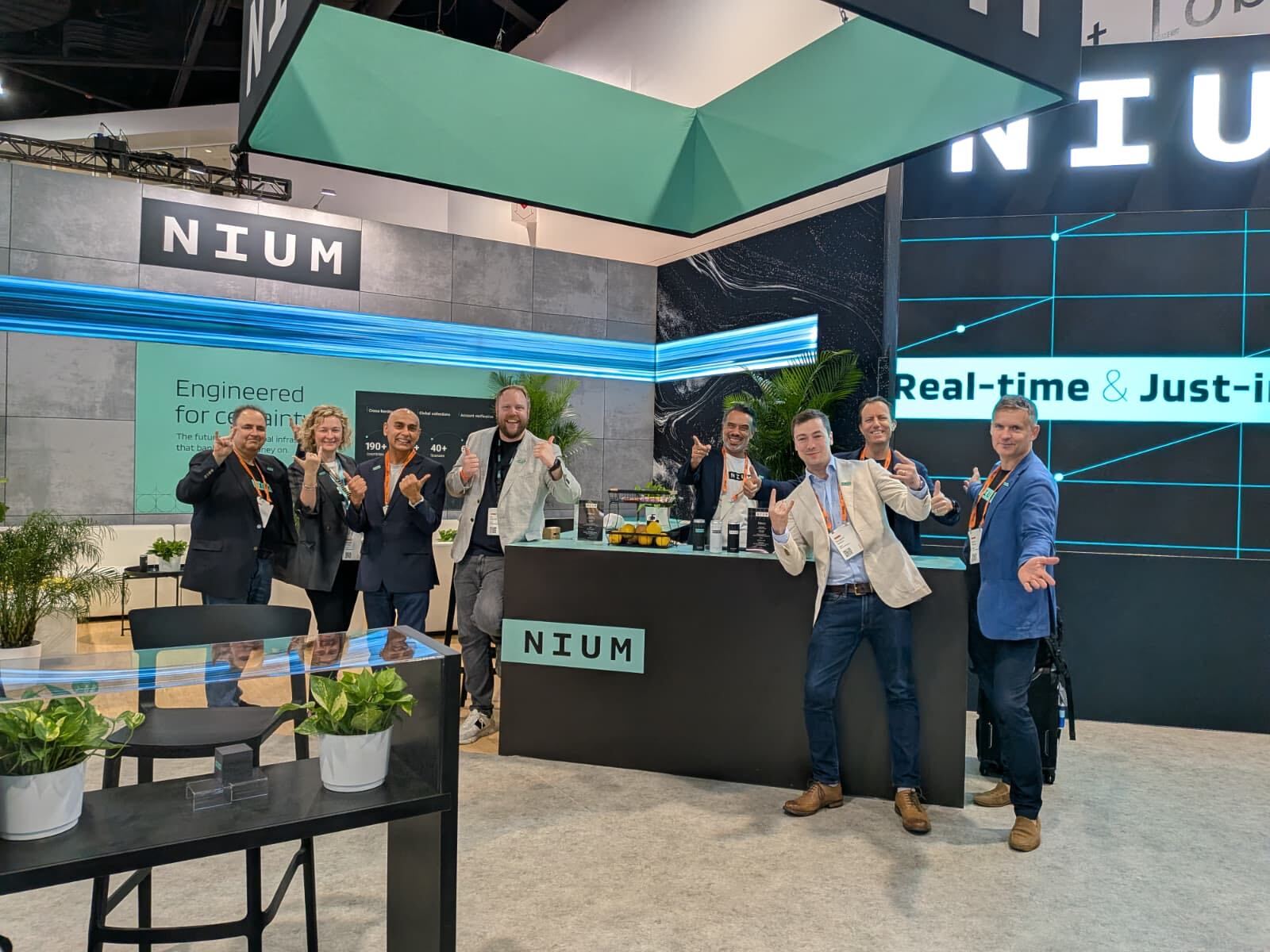
At Sibos 2026, Nium made itself hard to miss — from our booth at the Miami Beach Convention Center to the skies above, where our aerial banner flew strong.
But beyond the packed schedule, the week was defined by a more important conversation: what businesses need from cross-border payments today. The answer was clear. Not simply lower cost or faster speed, but certainty — across every aspect of money movement.
For Nium, Sibos was an opportunity to meet with hundreds of banking and FI customers and partners, while sharing our perspective on the infrastructure, partnerships, and payment experiences needed to make global money movement more dependable.
Here are our top takeaways from the event.
Certainty is the new currency
Our Chief Business Officer Anupam Pahuja opened the week on Sibos TV with a straightforward message: the real cost of a payment is not only the fee attached to it, but also what happens when it does not arrive as expected.
A late supplier payment can strain a relationship. A delayed payroll payment is likely to have immediate detrimental consequences for employees. A failed payment can disrupt operations, delay orders, and consume time and resources that should be focused on growing the business.
“It’s not about the cost of the payment. It is what happens if the payment doesn’t get there on time. It’s the certainty of payments that matters more than the actual cost of making payments.”
— Anupam Pahuja, Chief Business Officer, Nium
That message is reflected in our latest research with Celent, The Value of Certainty in Uncertain Times.
Nearly two-thirds of businesses (65%) want cross-border payments completed within minutes or instantly, yet only 18% report receiving that level of speed from their banking partners. The research also found that businesses spend more than $100,000 per year, on average, dealing with failed payments and their downstream effects.
The gap is not just about speed. It is about whether payment providers can deliver the kind of predictable outcomes that are now table-stakes to today’s customers: knowing that a payment will arrive when expected, at the price quoted, with visibility into its status along the way.
Reachable is not the same as trusted
Anupam continued the conversation on the Sibos main stage, joining leaders from Iberpay, Santander, Convera, and Emirates NBD to discuss interoperability and the changing payments playbook.
The key takeaway: the global payments ecosystem has become more connected, with more rails, currencies, networks, and ways to move value. But reach alone does not create confidence.
Making a market technically reachable is different from making a payment experience trusted. Businesses need to know that funds will move reliably across networks, that costs and timing will be clear before they send, and that they will have the visibility needed to manage payments when conditions change.
That is what interoperability should enable — not merely a connection between systems, but a more reliable end-to-end experience for the customer.
Stablecoins move from theory to application
Stablecoins were another major theme of the week, particularly as the industry considers how new forms of money can support faster, more flexible cross-border payments.
Rob Regan, EVP Americas at Nium, joined the Solana Foundation on stage to discuss where stablecoins fit into the future of cross-border money movement. Later that day, the Nium team also attended an AMA with Circle CEO and Founder Jeremy Allaire.
The conversation is moving beyond whether stablecoins are technically viable. The more practical question is how they can work within real payment experiences, alongside fiat, local payment networks, banks, compliance frameworks, and the businesses that depend on them.
For companies moving money internationally, the goal is not to add complexity or force an either-or choice between traditional payment rails and digital assets. It is to create more options: the right funding method, the right payment rail, and the right local delivery method for a given use case.
Nium is building toward that multi-rail future. Our infrastructure enables businesses to fund in USDC and deliver local-currency payouts across more than 190 countries, combining the flexibility of stablecoin funding with the local delivery capabilities global businesses need.
Bridging the corporate service gap
At the Nium booth, The Asian Banker interviewed Yogesh Sangle, EVP APAC at Nium, about a tension that surfaced repeatedly throughout the week: the difference between how banks believe they serve corporate customers and what those customers experience in practice.
Many banks rightly point to the strength of their relationships, their trusted brands, and the breadth of their services. But from a corporate’s point of view, service ultimately comes down to outcomes:
- Did the payment arrive on time?
- Did it arrive at the price quoted?
- Can the business see its status?
- Can someone resolve an issue quickly if something goes wrong?
Nium and Celent’s research found that 2 in 5 businesses do not feel they receive the level of service they need from their banks.
The path forward is not banks or fintechs; it is banks and fintechs, working together.
Banks bring trust, customer relationships, balance-sheet strength, and broad financial capabilities. Specialist payment infrastructure providers can complement those strengths with local connectivity, real-time capabilities, transparent FX, and the expertise required to manage complex cross-border flows.
Together, they can deliver a better experience for corporate customers.
The relationships behind the infrastructure
Some of the most valuable conversations at Sibos happened away from the stage.
Throughout the week, we connected with customers and partners from around the world – at our booth, at networking and side events, and over coffee. The highlight was Nium @ Nite, our dinner at Michelin-starred Stubborn Seed, where we created an intimate space to step away from the conference floor and build the deep peer relationships that help move the industry forward.
And, of course, none of it would have happened without the Nium team that built our exhibitor experience at Sibos, brought the brand to life across Miami Beach, and spent the week in countless conversations with attendees.
Sibos reinforced a conviction that guides Nium’s work every day: cross-border payments should not leave businesses guessing. They should be instant, transparent, connected, observable, and dependable from the moment a payment is initiated to the moment it reaches its destination.
Thank you to everyone who met with us in Miami. We leave Sibos with stronger relationships, deeper insights, and sharper focus on building the infrastructure for money movement that delivers certainty for everyone in the value chain.