
A playbook for financial institutions
TLDR:
Banks improved cross-border payouts.
A similar shift is now happening on the receivables side, but it is easier to miss. Fintechs are not just processing payments. They are increasingly becoming the account businesses use to operate.
What moves with that shift:
- FX margin: clients hold and convert on their own terms
- Transaction data: receivables and cross-sell signals sit outside the bank
- Processing fees: local rails reduce reliance on correspondent flows
- Daily activity: balances, conversions, and payments happen elsewhere
Deposits may not move immediately. Churn can look normal. These changes are gradual and often do not show up clearly in standard metrics.
The shift is already underway. The real question is how early institutions choose to respond.
1. History repeating itself: a familiar disruption pattern
Over the past decade, banks have undergone a fundamental shift in how cross-border payments are delivered.
Historically, correspondent banking networks formed the backbone of international payouts. While robust, these systems were often characterised by high costs, long settlement times, and limited transparency. Fintech entrants identified these gaps as opportunities to introduce alternative models focused on speed, cost efficiency, and user experience.
Banks were initially slow to respond. As a result, customer expectations shifted quickly, and fintechs captured a meaningful share of the payments value chain.
In time, banks adapted.
Through investments in faster payment rails, real-time infrastructure, and strategic partnerships, they regained ground. Real-time payments are now growing at over 40% annually, and faster payouts are increasingly becoming standard across markets.
This response demonstrated that banks can successfully evolve when a threat is clear and is prioritised. However, while banks were focused on improving how money moves out, a parallel shift was taking place, less visible, but equally significant.
Control over how money comes in has been steadily moving elsewhere.
Today, the same disruption pattern is re-emerging, this time on the receivables side. Unlike the earlier wave, this shift is occurring at the point where funds enter the financial system, which is also where transaction value is first established.
2. The shift: receivables as the new battleground
Industry attention has historically centred on cross-border disbursements. Yet, the more consequential transformation is now occurring on the receivables side of transactions.
Fintech platforms such as Wise, Payoneer, Revolut, and Airwallex have expanded their capabilities beyond payments processing to become global collection platforms. These platforms are no longer just payment processors - they are becoming the primary operating accounts for cross-border businesses.
This positioning aligns closely with underlying trade and payment dynamics:
- The United States, United Kingdom, and Europe remain primary sources of outbound cross-border payments
- Southeast Asia and parts of Europe are among the fastest-growing recipient regions
- Small and medium-sized enterprises (SMEs) and digital-native businesses increasingly operate across multiple currencies
These dynamics concentrate activity in high-volume corridors, precisely where fintech platforms have established strong capabilities.
Importantly, a significant share of cross-border transaction volume is driven by receivables rather than payouts. By embedding themselves at the point where funds are received, fintech providers are positioning themselves at the centre of:
- High-frequency transaction flows
- Foreign exchange (FX)-sensitive activity
- Digitally enabled business models
This shift is subtle but material.
The institution that controls receivables increasingly influences the broader customer relationship, including FX, liquidity management, and downstream payments.
3. How multi-currency collections work: the local account model explained
At the centre of this shift is a specific operating model: multi-currency collections.
Multi-currency collections allow businesses to receive cross-border payments using locally issued account details in multiple markets - while holding each currency separately without automatic conversion.
While many banks are familiar with the underlying infrastructure, the model is often not fully productised within traditional banking offerings. As a result, its implications are frequently underestimated.
The local account model
The core concept is straightforward.
A business can be assigned locally domiciled account details in multiple foreign markets, enabling it to receive payments as if it were a domestic entity in each of those markets.
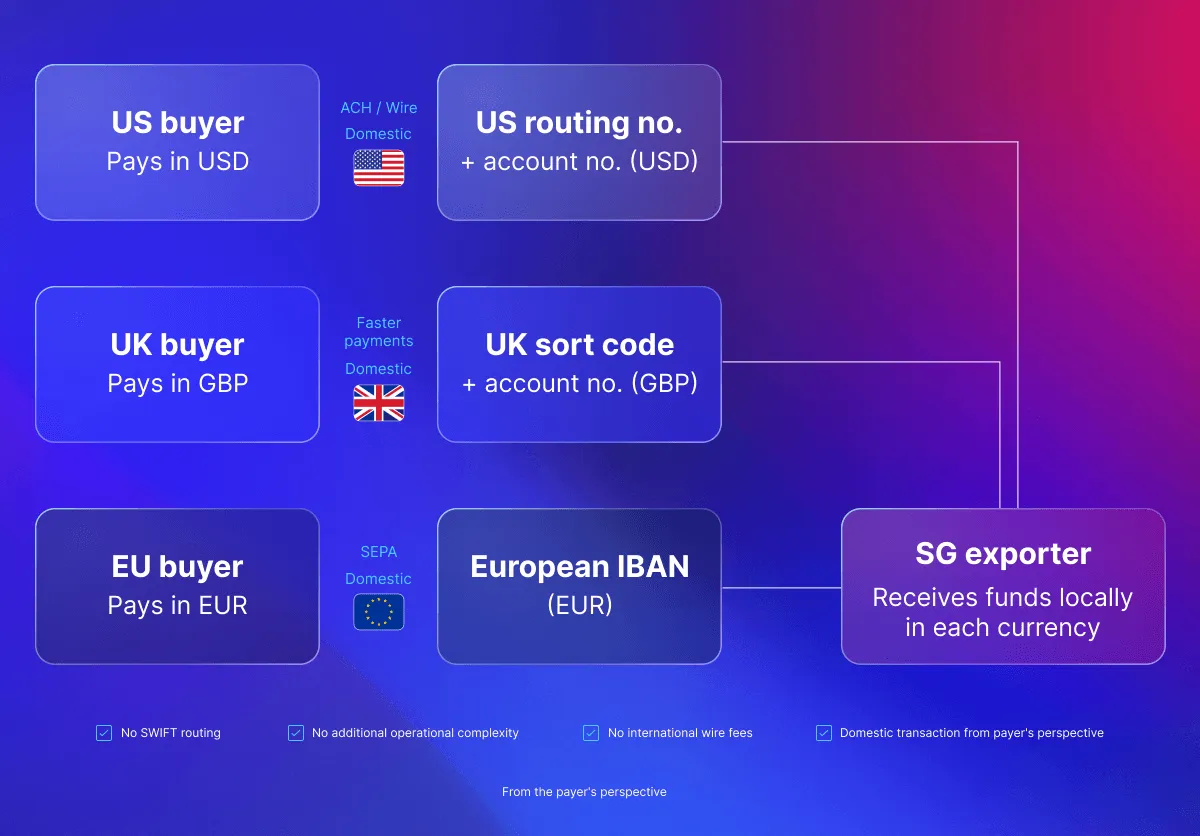
For example, a Singapore-based exporter may be provisioned with:
- A US routing number and account number (USD)
- A UK sort code and account number (GBP)
- A European IBAN (EUR)
These account details function as locally recognisable receiving endpoints within each jurisdiction.
When a payer initiates a transaction:
- A US buyer pays via domestic rails (e.g., ACH or wire) in USD
- A UK buyer pays via Faster Payments in GBP
- A European buyer pays via SEPA in EUR
From the payer’s perspective, the transaction is domestic:
- No SWIFT routing
- No international wire fees
- No additional operational complexity
Cross-border payments are effectively transformed into domestic transactions at the point of initiation.
End-to-end experience
From a business perspective, the experience is operationally simple and consistent: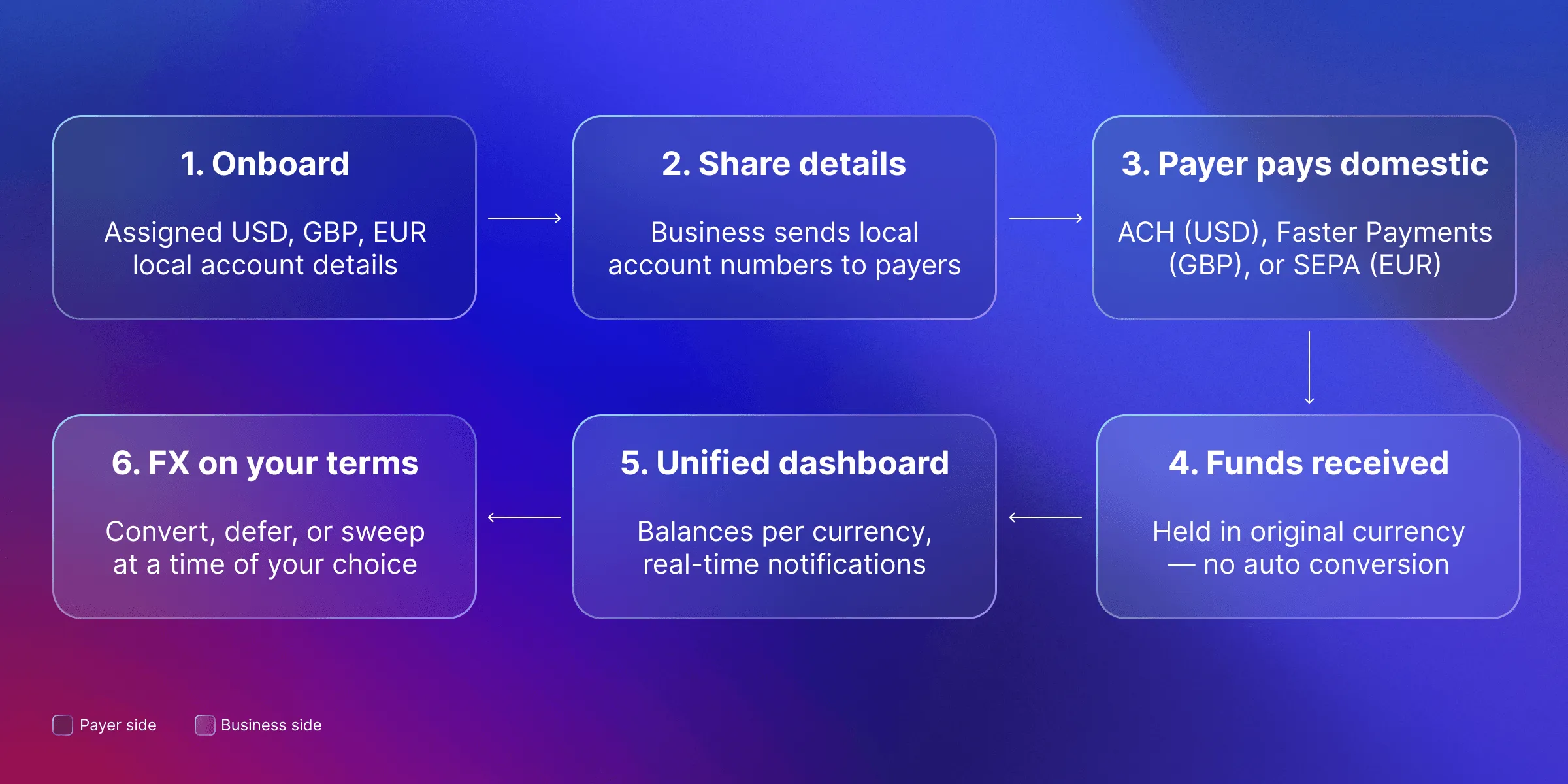
- Onboarding and setup
The business is onboarded and assigned local receiving account details across key currencies (typically USD, GBP, EUR, and others as required). - Sharing payment details
The business provides the relevant local account details to its international customers. - Domestic payment initiation
Each payer initiates a domestic payment in their own country and currency using familiar local rails. - Receipt of funds
Funds are received into the multi-currency account and held in the original currency. - Centralised visibility
The business accesses a unified dashboard showing:
a. Balances by currency
b. Incoming payment notifications
c. Transaction-level detail - FX and liquidity control
The business determines when and how to convert funds:
a. Immediate conversion
b. Deferred conversion based on market conditions
c. Direct use in original currency
d. Sweep to a primary operating account
This model shifts control over FX timing, pricing, and liquidity management from the bank to the customer.
What “multi-currency” means in practice
The term “multi-currency” is often used broadly, but in this context, it has a precise meaning.
It does not refer to a single account with automatic currency conversion.
Instead, it refers to the ability to hold and manage multiple currencies independently.
- USD balances are held as USD
- GBP balances are held as GBP
- EUR balances are held as EUR
There is no automatic conversion upon receipt.
This is a critical distinction.
In traditional banking models, inbound cross-border payments are frequently converted into the account’s base currency upon arrival, often at a bank-determined rate. This limits the customer’s ability to manage FX exposure.
Multi-currency collections reverse this dynamic by:
- Preserving the original currency
- Providing transparency over FX rates
- Allowing the customer to determine conversion timing
Traditional vs Multi-Currency Account Collections
The difference between the traditional collections and multi-currency collections models can be summarised as follows:
| Traditional cross-border collections | Multi-currency account collections |
| Business provides SWIFT/BIC details | Business provides local account details |
| Payer initiates international wire | Payer initiates domestic payment |
| Settlement: 2–5 days | Settlement: same day or next day (market dependent) |
| Correspondent banking fees ($25–$40 typical) | No correspondent banking fees |
| FX applied automatically on receipt | FX controlled by the business |
| Limited visibility and complex reconciliation | Centralised visibility and simplified reconciliation |
The innovation lies not in a single component, but in the orchestration of a more efficient and customer-centric experience.
Implications for banks
In traditional models, banks control key elements of the transaction lifecycle:
- Payment routing
- FX conversion
- Pricing and margins
In the multi-currency model, much of this control shifts outward:
- Payment initiation occurs via local rails outside traditional cross-border infrastructure
- FX conversion is deferred and often executed externally
- Customer interaction increasingly takes place within fintech interfaces
As a result, banks may retain deposits but lose participation in the transaction layer where value is created.
4. What banks are losing - and why it’s hard to see
The impact of this shift is not immediately visible within traditional banking metrics.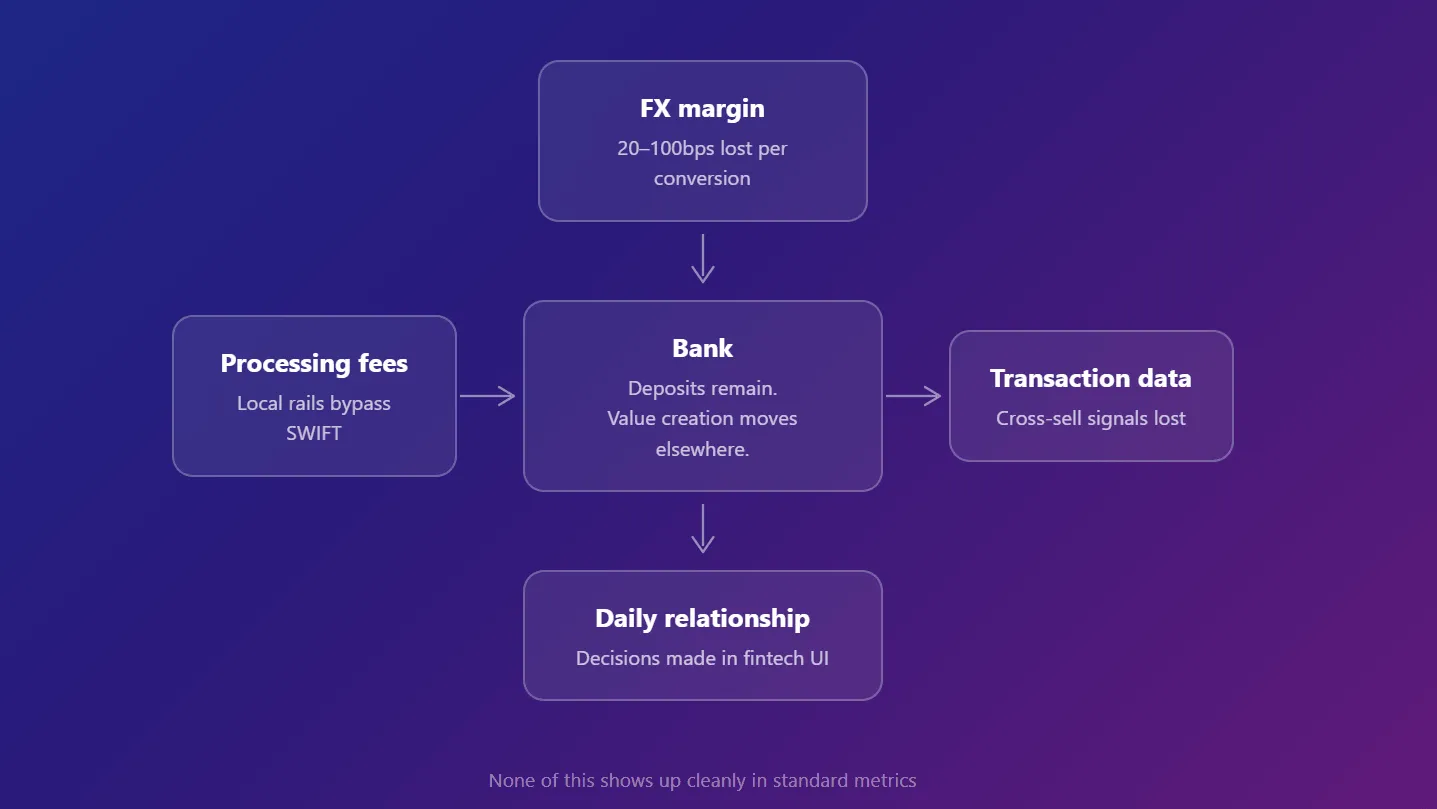
Customer relationships often appear stable:
- Deposits remain with the bank
- Lending relationships are unaffected
- Churn indicators show limited change
However, transactional behaviour is evolving in ways that are not fully captured.
Specifically:
- Incoming payments are increasingly routed through external platforms
- FX conversion is executed outside the bank’s infrastructure
- Transaction-level visibility is reduced
Banks are, in effect, becoming custodians of funds rather than active participants in the transaction lifecycle.
This has direct implications for revenue.
Foreign exchange remains a significant contributor to cross-border banking profitability, with margins typically ranging from 20 to 100 basis points, based on Nium's transaction banking data.
As receivables shift externally, banks forgo:
- FX-related income
- Payment processing fees
- Data-driven cross-sell opportunities
A key challenge is that this revenue erosion is distributed and difficult to measure.
It spans multiple business units and is rarely captured within a single reporting framework. As a result, it is often deprioritised until the financial impact becomes more pronounced.
By that stage, customer behaviour may already be entrenched.
5. Strategic response: build, buy, or partner
Addressing this shift requires a clear strategic response. Broadly, banks have three options:
1. Build
Develop multi-currency collection capabilities internally.
- Full control over infrastructure and customer experience
- High cost and long development timelines
- Significant dependency on legacy systems
This approach offers control but may limit speed to market.
2. Buy
Acquire or integrate existing capabilities.
- Potentially faster than building
- Integration and alignment challenges
- Ongoing operational complexity
3. Partner
Leverage infrastructure providers to enable capabilities through API-based models.
- Faster time to market
- Minimal disruption to core systems
- White-label or embedded experiences
- Retention of the customer relationship
Partnership-led models address one of the most significant barriers: implementation complexity. This model mirrors how banks successfully scaled payouts - through infrastructure partnerships rather than full-stack rebuilds.
They allow banks to:
- Introduce capabilities incrementally
- Avoid large-scale core system changes
- Deploy solutions within months rather than years
Most importantly, they enable banks to reclaim control over receivables and associated revenue streams without rebuilding their entire payments infrastructure.
6. Why banks that act now will retain the transaction layer
Banks continue to hold significant structural advantages:
- Established trust
- Strong balance sheets
- Regulatory expertise
- Deep customer relationships
These attributes are no longer enough to lead in global payments.
Value is moving to the institutions that control transaction flows, not just hold funds.
Multi-currency collections are already gaining momentum. Institutions that move early can stay closer to these flows.
Those that wait may still hold deposits, but they risk losing visibility into the activity, data, and revenue tied to the customer relationship.